
Artificial intelligence has completely changed content creation.
Today, bloggers can generate articles in minutes, businesses can publish content at scale, and marketers can produce more content than ever before. But one important question remains:
Can AI-generated content actually rank on Google?
The short answer is “yes”.
AI content can rank extremely well on Google. Google has publicly stated that it focuses on the quality of content rather than the method used to create it. Thousands of websites already receive significant traffic from AI-assisted content.
However, simply asking an AI tool to write an article and publishing it without improvement rarely works anymore.
Google does not reward content because it was written by a human.
Google does not punish content because it was written by AI.
Google rewards content that helps people.
If your AI-assisted article provides value, answers questions clearly, demonstrates expertise, and gives users a better experience than competing pages, it can rank just as well as human-written content.
This guide explains exactly how to do that in 2026.
Why Most AI Content Fails to Rank
The problem is not AI. The problem is low-quality AI content. Many website owners make the same mistake.
Their process looks like this:
- Enter a keyword.
- Generate an article using AI.
- Publish immediately.
- Wait for rankings.
Unfortunately, this approach almost never works in 2026.
Search engines have become extremely good at identifying shallow content that adds little value.
Common reasons behind the failure of AI content to rank:
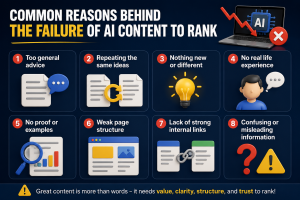
- Too general advice
- Repeating the same ideas
- Nothing new or different
- No real life experience
- No proof or examples
- Weak page structure
- Lack of strong internal links
- Confusing or misleading information
The good news is that all of these problems are easy to fix. Let’s see how.
Step 1: Start with Search Intent
Search intent refers to the purpose behind a user’s search query. It helps determine what kind of information or solution the user is looking for. Understanding search intent allows you to create content that directly meets user needs and improves search rankings.
If someone searches for “How to rank AI content on Google,” they are not looking for definitions, history lessons, or industry news. Instead, they want a practical step-by-step guide. Before writing any article, ask yourself what the reader actually wants.
There are four major types of search intent:
Informational
The user wants to learn or understand a topic.
Example:
- How can AI generate realistic images?
- How to write AI image prompts like a pro ?
Navigational
The user is trying to reach a specific website, tool, or service.
Example:
- OpenAI image generator
- Midjourney official website
Commercial Investigation
The user is comparing options before making a decision or purchase. .
Example:
- Best AI image generators for professional designers
- ChatGPT vs Midjourney for AI image generation
Transactional
The user is ready to take action, such as signing up, buying, or using a tool immediately.
Example:
- Buy Midjourney subscription
- Generate AI images online for free
Understanding intent is the foundation of ranking.
Step 2: Choose the Right Keywords
Choosing the right keywords is one of the most important steps in ranking AI content, yet many creators approach it incorrectly.
Instead of focusing only on popular keywords, you should understand the benefits of targeting low-competition keywords, especially if your website is new or has low authority.
Low-competition keywords are easier to rank for because fewer websites are targeting them. This allows you to gain traffic faster and build authority over time.
Let’s compare high-competition and low-competition keywords:
High-competition keyword example:
- Healthy breakfast
Low-competition keyword example:
- healthy breakfast food for weight loss beginners
Now compare their characteristics:
High-competition keyword:
- Keyword difficulty: Very high
- Search volume: High
- Competition: Strong (large websites, established brands)
- Ranking difficulty: Hard
Low-competition keyword:
- Keyword difficulty: Low to medium
- Search volume: Lower but more targeted
- Competition: Weaker (smaller or newer websites)
- Ranking difficulty: Easier
Although low-competition keywords may have less search volume, they often bring more relevant visitors who are looking for specific answers. Start with low-competition keywords to build authority.
After selecting your primary keyword, research 10–15 relevant supporting keywords. Then, instruct your AI writing tool to naturally incorporate these supporting keywords throughout the blog. This is a smart SEO strategy that helps improve topical relevance, increases your chances of ranking for multiple search queries, and enhances the overall quality of the content.
Example keyword structure:
Primary keyword:
- healthy breakfast food for weight loss beginners
Supporting keywords:
- low calorie breakfast ideas
- high protein breakfast for weight loss
- easy healthy breakfast recipes for beginners
- quick breakfast ideas for weight loss
- best breakfast foods for fat loss
- simple breakfast meals for beginners
- healthy morning meals for weight loss
- low carb breakfast options
- beginner friendly weight loss breakfast recipes
Avoid keyword stuffing. Modern search engines understand context, so focus on clarity, relevance, and usefulness rather than repeating the same phrase excessively.
Step 3: Build Topical Authority
Publishing one article about healthy breakfast food for weight loss beginners is rarely enough.
Search engines prefer websites that cover an entire topic in depth.
This is known as topical authority.
Instead of creating just one post, build a content cluster around your main keyword.
Example:
Main article:
- Healthy Breakfast Food for Weight Loss Beginners
Supporting articles:
- Easy Low-Calorie Breakfast Ideas for Beginners
- High-Protein Breakfast Foods for Weight Loss
- Best Smoothies for Weight Loss in the Morning
- Meal Prep Breakfast Ideas for Busy Beginners
- Foods to Avoid at Breakfast When Trying to Lose Weight
- Healthy Breakfast Recipes Under 300 Calories
When these articles are connected through internal links, search engines recognize that your website provides comprehensive and valuable information on the topic.
Step 4: Add Human Experience
This is one of the biggest ranking factors in 2026.
Readers want experience.
Search engines want experience.
AI cannot cook meals.
AI cannot follow a diet plan.
AI cannot share real-life weight loss journeys.
But you can.
Examples include:
- Personal meal plans
- Before and after results
- Daily breakfast routines
- Weight loss progress
- Calorie tracking examples
- Healthy recipe experiments
- Real beginner experiences
Instead of saying “Healthy breakfast helps with weight loss.” Say– “After switching to a high-protein breakfast like oats with eggs and fruits, I lost 4 kg in 6 weeks while feeling more energetic throughout the day.”
Experience creates trust. Trust creates results.
Step 5: Add Information Gain
Information gain means providing something new.
Most AI articles fail because they simply repeat existing information.
Google already has millions of articles saying:
“Write quality content.”
That advice adds no value.
Instead provide:
- Original data
- Surveys
- Experiments
- Templates
- Checklists
- Frameworks
- Examples
Ask yourself:
“What can readers learn here that they cannot find elsewhere?”
That answer is your competitive advantage.
Step 6: Improve E-E-A-T Signals
E-E-A-T stands for:
- Experience
- Expertise
- Authoritativeness
- Trustworthiness
This concept plays an increasingly important role in search rankings.
Ways to improve E-E-A-T include:
Use an Author Bio
Tell readers who wrote the article and why they are qualified.
Include Sources
Back up important claims with reliable sources.
Add Real Examples
Examples increase credibility.
Keep Content Updated
Outdated information reduces trust.
Use Clear Language
Confusing content creates a poor user experience.
Step 7: Edit AI Content Like a Human Editor
Never publish raw AI output. Always edit.
A simple editing workflow looks like this:
Research → AI Draft → Fact Checking → Human Editing → Examples → Internal Links → Publishing
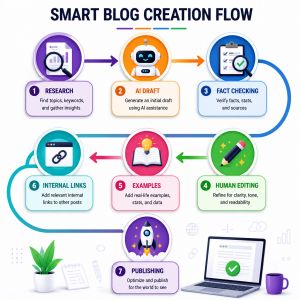
The editing stage often determines whether an article succeeds or fails.
Step 8: Fact Check Everything
Trust is difficult to build and easy to lose. AI occasionally produces incorrect information.
This is sometimes called hallucination.
Always verify:
- Statistics
- Dates
- Names
- Quotes
- Studies
- Laws
- Product specifications
Step 9: Use Related Topics Naturally
Search engines can understand how different ideas are connected.
For example:
Healthy food is connected to:
- Balanced nutrition
- Fresh ingredients
- Portion control
- Meal planning
- Hydration
- Overall well-being
When you include these related topics in your article, it helps search engines better understand what your content is about.
Step 10: Structure Content Properly
Good page structure improves both readability and rankings.
A strong structure includes:
- One H1 heading
- Logical H2 headings
- Supporting H3 headings
- Short paragraphs
- Bullet points
- Tables
- Examples
Use related keywords in H2, H3 tags.
Step 11: Optimize for Featured Snippets
Featured snippets still drive valuable traffic.
To increase your chances:
- Answer questions directly.
- Use numbered lists.
- Use bullet lists.
- Keep answers concise.
Example:
Question: Can AI content rank on Google?
Answer: Yes. AI-generated content can rank if it is helpful, accurate, and satisfies user intent.
Step 12: Optimize for AI Overviews
Search is changing rapidly. Many users now receive AI-generated summaries before clicking websites.
To become a source for these summaries:
- Answer questions clearly.
- Use factual language.
- Include statistics.
- Use structured headings.
- Add expert opinions.
- Include original research.
AI systems prefer content that is easy to understand and easy to quote.
Step 13: Improve Internal Linking
Internal links remain one of the easiest ranking wins.
Benefits include:
- Better crawling
- Better user experience
- Increased page authority
- Improved engagement
Good internal linking examples include:
- Related tutorials
- Supporting articles
- Beginner guides
- Tool reviews
Aim for relevance rather than quantity.
Step 14: Improve User Experience
Google measures user satisfaction.
Questions to ask:
- Does the page load quickly?
- Is the text easy to read?
- Are paragraphs short?
- Are images optimized?
- Is navigation simple?
User experience affects rankings more than many people realize.
Step 15: Keep Content Updated
Fresh content performs better.
Review important pages regularly.
Update:
- Statistics
- Examples
- Screenshots
- Strategies
- Recommendations
A small update can sometimes improve rankings dramatically.
Common Mistakes to Avoid
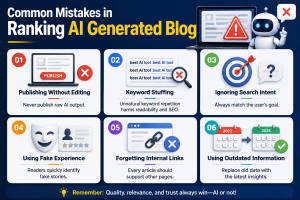
Publishing Without Editing
Never publish raw AI output.
Keyword Stuffing
Unnatural keyword repetition harms readability and SEO.
Ignoring Search Intent
Always match the user’s goal.
Using Fake Experience
Readers quickly identify fake stories.
Forgetting Internal Links
Every article should support other pages.
Using Outdated Information
Replace old data with the latest insights.
Frequently Asked Questions
Can AI-generated content rank on Google?
Yes. AI-generated content can rank if it provides value, satisfies user intent, and demonstrates expertise and trustworthiness.
Does Google penalize AI content?
No. Google evaluates content quality rather than the tool used to create it.
Can AI content rank without backlinks?
Yes for low competition keywords, although backlinks remain important for competitive topics.
Is AI-written content considered spam?
Only if it exists primarily to manipulate rankings without helping users.
How much human editing should AI content receive?
Enough to improve accuracy, readability, expertise, and originality.
Can AI write an entire blog post?
Yes, but human review and enhancement significantly improve ranking potential.
How do I optimize AI content for search engines?
Focus on search intent, structure, internal links, factual accuracy, and unique insights.
What is E-E-A-T?
Experience, Expertise, Authoritativeness, and Trustworthiness.
Does Google detect AI-generated content?
Google may identify patterns associated with low-quality automation, but it focuses primarily on content quality rather than detection.
Is AI content the future of SEO?
AI-assisted content is likely to become standard practice, but human expertise will continue to separate average content from exceptional content.
Before You Go
The biggest misconception in SEO today is that Google ranks human content and rejects AI content, but that is not how modern search works. Google ranks useful content, regardless of how it is created. If AI helps you produce better content more efficiently, it should be used, and if human expertise enhances that content’s value, it should be added. The future belongs to creators who effectively combine both approaches. The winning strategy for 2026 is simple: use AI for speed, rely on humans for quality, and by blending the two, you can create content that both readers and search engines appreciate.